
The Phoenician Scheme
Wes Anderson (2025)

The Phoenician Scheme - Wes Anderson
3.5/5
Zadie Smith in The New Yorker (March 2020) reflected upon Trump’s pronouncement at the beginning of the pandemic that “I wish we could have our old life back. We had the greatest economy that we’ve ever had, and we didn’t have death.” She then goes on to talk about how a facet of American exceptionalism is its tendency to ignore life’s culmination in death. America, she writes, sees death as just an aberration, a product of other things such as war, race or poverty. I was reminded of that essay in the opening of Anderson’s latest film The Phoenician Scheme, in which industrialist Zsa-zsa Korda (Benicio del Toro) stumbles out of a plane crash into the frame of a news camera reporting on his own death. Back in his lavish home, he instructs his daughter Liesl (Mia Threapleton) on becoming his heir, and on his grand scheme to build elaborate infrastructure and public works in Phoenicia. Liesl, training to become a nun, is at first suspicious of her dirty, sinful and strikingly Godless father. All the while, Hans Holbein the Younger’s “The Ambassadors” (painting) is sitting on a wall in the background.
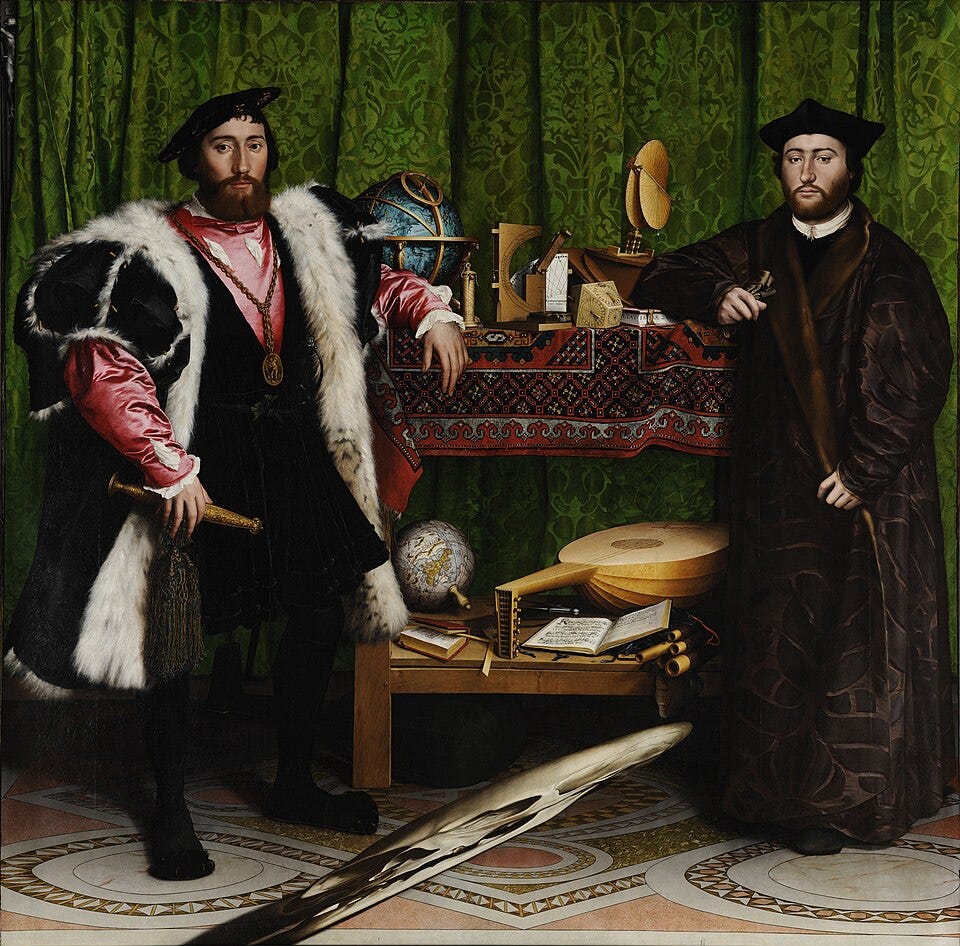
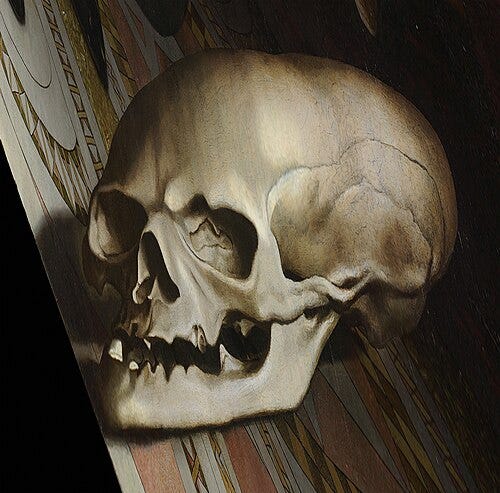
“The Ambassadors” (1533) is a painting which has commonly been interpreted as depicting a conflict between secular and religious authorities. Jean de Dinteville, a landowner, faces Georges de Selve, a Catholic bishop. In between them sit two shelves holding an assortment of items symbolising the secular/religious conflict, including one terrestrial and one celestial globe. The painting was commissioned to be placed at the bottom of a flight of stairs. Facing the painting from the front, there is a strange distorted object on the ground in between the two figures, but from the perspective of the top of the staircase it looks like a skull. Death, in this painting, is lost from perspective, much as it appears lost from the perspective of our protagonist Korda throughout the film.
Korda and Liesl team up to secure more and more unattainable loans from family members in order to finance the infrastructure project in Phoenicia. They are joined by Bjorn (Michael Cera), an entomology professor employed to keep up the secular education of Korda’s nine young sons. But there is a conspiracy afoot! Throughout the film we return to a boardroom meeting of Korda’s business rivals. They are united by not much except their loathing of him, and they are intent on sabotaging his project by withholding supply of key goods. They cite his flouting of international trade regulations as a reason for their hating him. This conspiracy of elites, the opulence of Korda’s dwelling (he tells one of his sons to “never buy good paintings - buy the best paintings”) and the nine sons he has by many wives, indicates that Korda is a Trump/Musk figure. Like Trump and Musk, being the dirtiest of businessmen, Korda is unfazed by assassination attempts - he has already hired all the worst criminals on the face of the Earth, and so can recognise them from a mile away.
As the film progresses, our faith in both religious and secular readings of the events of the film are undermined. Liesl’s religious faith becomes more and more transactional. At first, Liesl is suspicious about reuniting with her father. What would the Lord think of such an unfaithful man? And such a rich one unwilling to give to those in need? But Korda woos her with luxurious secular counterparts to the sparse trinkets and clothing of the abbey. Eventually the Reverend Mother visits to insist that Liesl’s path of Lordly devotion lies outside the nunnery, but instead that she might consider donating some of her father’s wealth to the church. Even as religious faith begins to seem more shallow, Korda’s quest to raise capital becomes less secular and more miraculous. Liesl’s prayers seem to help a Phoenician prince allied to Korda, who has never played basketball, land a half-court shot to secure funding from relatives of some sort or another (Tom Hanks, Bryan Cranston). And Korda is troubled by dreams or visions of being judged in purgatory. This prompts him to reconsider his prior faithlessness. The increasingly miraculous feats by which Korda secures funding for his project don’t prevent it from seeming ever more untenable to the sober-minded, but sobriety seems increasingly unwarranted as regards the film. The film effectively charts secular knowledge and religion becoming more and more vacuous. Many of the events of the film take place in Phoenicia rather than a modern nation, making the film resemble a crappy knock-off Biblical allegory. And are we not living in a crappy knock-off Biblical allegory when Trump announces a desire to make Gaza into “the Riviera of the Middle East”?
When Josh Larsen (Filmspotting) argues that the religious content of the film is quite thin, he is right. We could also say that the film deals with science and secular culture quite thinly. Although maybe that is the film’s point: religiosity and secular knowledge have been made quite thin in modernity by capitalists like Korda, who were at one stage or another their champion. I still think the film portrays no countervailing hope, or a lack of positive meaning, which notably contrasts with the best of Anderson’s previous work: I am thinking of characters including the chef in French Dispatch who has sampled all of life’s tastes except poison, or the two actors in Asteroid City who meet briefly on the fire stairs at the back of their theatres before the curtains open.
Capitalists are “a band of warring brothers”, to quote Marx, and are subject to a dynamic of competitive accumulation which means they must keep building even when the funds dry up, and all of this is effectively portrayed in the film. They must continue to demand ideological supremacy and warp science and morality/religion to ignore the possibility of death or crisis, and I think del Toro’s unabashed and unfounded confidence fits well with the demands of the character. Michael Cera is second-to-none, alternatingly shallow and alive with feeling at precisely the moments where the role demands it. It is not Anderson’s best work, but nevertheless much better than most films I have seen in the two years since Asteroid City.